
Companion post to the November 19 issue of AI Beat.
The week healthcare stopped talking about pilots
Three healthcare AI stories landed this week, and not one of them was about a pilot.
OpenAI gave ChatGPT for Healthcare computer-use agents that read a screen, click and type their way through EHRs, scheduling systems and payer portals. Apple opened a study of up to 200,000 adults to learn how people use and trust conversational health AI. And the American Medical Association asked lawmakers to shield physicians when an AI product injures a patient even though the doctor used it as intended.
Read those three together. One is about AI doing real work inside production software. One is about whether patients will trust it. One is about who pays when it fails. Those are deployment questions. Nobody argues about liability for a demo.
I think that shift matters well beyond hospitals. Healthcare is the hardest room in applied AI: regulated, high stakes, and full of software older than most of the startups selling into it. If a buying question holds up there, it holds up in your industry too.
So this week I want to do two things. First, name why AI stalls between the demo and the deployment. Second, give you the five questions I would put to any vendor before signing.
Why AI stalls between the demo and the deployment
Only 4% of health system technology leaders say they have scaled AI with measurable outcomes. That number comes from Qventus' 2026 CIO report, a survey of more than 60 CIOs, Chief AI Officers and senior IT leaders at U.S. hospitals and health systems. In the same survey, 45% named difficulty scaling pilots as a top obstacle.
The other 96% are not short on pilots. They are short on a way out of them. I see four reasons, and none of them is the model.
The pilot was graded like a demo. It impressed a room. Nobody agreed up front which number had to move, so nobody can prove it moved.
The real work lives in old software. In that Qventus survey, 74% called dependence on their EHR a top barrier to execution. A tool that works in a sandbox and cannot reach the system of record is a science project.
Nobody owns it after launch. Half of those leaders (51%) said vendor management, integrations and implementations already eat 11% to 25% of their IT capacity. Every new tool joins that queue.
Nobody knows who is on the hook. The AMA's ask this week exists because the answer today is usually "the person closest to the patient," whether or not they could have caught the error.
Notice what this week's news does to that list. Agents that click through existing screens go straight at the second problem. They make the third and fourth ones bigger. An agent that can act inside your system of record needs an owner and a liability answer before it needs a launch date.
Five questions to ask before you sign
These work for a hospital buying a triage tool. They work just as well for a bank buying a service agent or a manufacturer buying a scheduling copilot.
1. Where is this running in production today, and can I talk to the people using it?
Ask for a named customer, a named workflow and a go-live date. A logo slide is not an answer. A reference call with the person who uses the tool on a Tuesday afternoon is. If every reference is a pilot, you are being asked to fund the vendor's learning curve. That can be a fine deal, as long as you price it like one.
2. What can it touch, and what happens when it is wrong?
This question got sharper this week. An agent that reads screens and clicks buttons can reach anything a logged-in employee can reach. Ask for the list of systems, the permissions in each, and the exact step where a human reviews the work before it lands. OpenAI reported that physicians rated 99% of 325 reviewed EHR inbox tasks as clinically safe. That is a strong number, and it is still the vendor's number on the vendor's test. Ask what the failure looked like in the other 1%, then ask how your team would have caught it.
3. Who is liable, and where does the contract say so?
The AMA wants AI companies to carry liability insurance and to disclose their products' limitations. You do not need to wait for a law to ask for both. Read the indemnification clause. Ask what the vendor's insurance covers. Ask for the documented limitations and performance data in writing. If the contract puts every failure on your staff, you have learned how much the vendor trusts its own product.
4. What number moves, from what baseline, by when?
Pick one metric before the kickoff: minutes per note, days to prior authorization, cost per claim, time to first response. Measure it before the tool arrives. Write the target and the date into the statement of work. My bet is that this habit explains much of the gap between the 4% and everyone else, because "measurable outcomes" requires that someone measured.
5. Who owns it on day 91?
Launch is the easy part. Ask who monitors accuracy after go-live, who gets the alert when the underlying model changes, and how many hours a week your own team will spend keeping it running. Then ask how you leave: what happens to your data, your prompts and your workflows if you switch vendors. A tool with no named owner on your side and no exit on theirs will end up back in the pilot pile.
Five questions, one test. If a vendor answers all five with specifics, you are looking at something deployed. If the answers are roadmap items, you are looking at a demo with a price tag.
Go hear it from the people who shipped
The fastest way to learn what deployed looks like is to sit in a room with people who have done it and ask what broke.
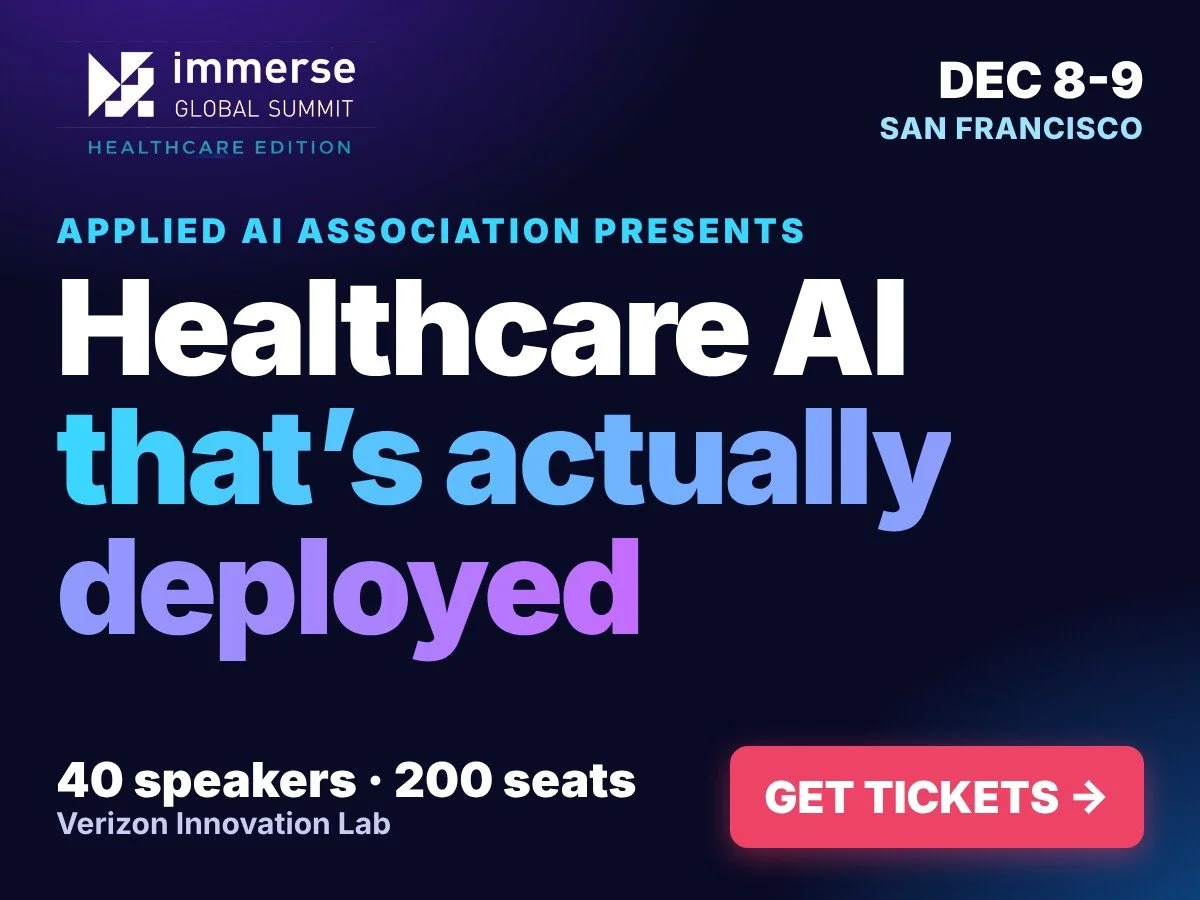
That is why we built the Immerse Global Summit Healthcare Edition, December 8-9 at the Verizon Innovation Lab in San Francisco. Harvey Castro, MD, is walking through AI-driven triage at the bedside: what worked, what broke, and what to ask before you sign. AWS is covering the move from spatial computing to physical AI. Toborlife AI is bringing a live robot on stage. UCSF is talking about preparing the next generation of clinicians for AI. The closing panel takes on governing all of it, from principles to standards.
There are 40 speakers and only 200 seats. AAIA members get complimentary General Admission with their membership; email nathan@aaiaglobal.com for your member code.
Interested in sponsoring or exhibiting? See the IGS Healthcare prospectus. Not a member yet? Request membership info.
Want this in your inbox every week? Subscribe to AI Beat.
Sources
HLTH26: OpenAI Expands ChatGPT for Healthcare, HIT Consultant, November 16, 2026
Apple, OpenEvidence launch conversational health AI study and app, Healthcare Dive, November 16, 2026
Doctors want liability shield from AI mistakes, Axios, November 13, 2026
Qventus Releases Second Annual CIO Report, Business Wire, April 9, 2026